In the high-stakes realm of contemporary serious oversteer competition, podium finishes is no longer solely a function of raw horsepower or driver bravado. Instead, it is now a multifaceted engineering challenge which necessitates a scrupulous blend of picking a time-tested vehicle platform, outfitting it with the most precise drift-spec parts, and, most importantly, comprehending its real-time performance on the circuit through sophisticated drift telemetry software. This definitive manual functions as your master plan starting from the very first idea of a drift build through to the last engineering-refined refinements that turn a powerful machine into a consistent champion. We will delve deep into the methodical process of vehicle alignment optimization, illustrating how a state-of-the-art suspension tuning tool like a dedicated telemetry system eliminates guesswork and delivers exceptional insight into your car's real-world behavior.
The foundation of any successful drift machine is, undoubtedly, the platform itself. A select group of cars have attained legendary standing within the global drifting culture due to their built-in weight distribution, robust build quality, and the vast range of specialist components available. Choosing the right platform is the initial and most important choice a builder will make. For instance, the BMW E36 is widely regarded as one of the best overall drift platforms of history. Its near-perfect evenly distributed mass, combined with a RWD setup and robust six-cylinder motors, creates a chassis that is at once accessible for newcomers and highly effective in the control of a expert pilot. The next step of this lineage, the E46 model BMW, improves on these qualities with a more sophisticated frame, wider track for improved high-speed stability, and even increased turning capability as standard from the OEM. Another powerful contender in the professional arena is the Chevrolet Corvette C6.
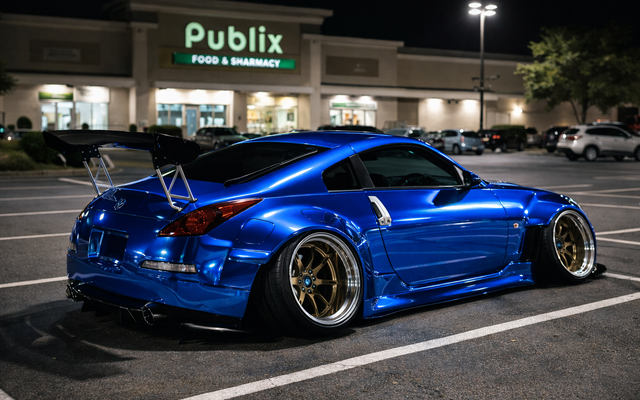
This muscle-derived track weapon offers a distinctive array of strengths to the sliding discipline, such as a low-mass aluminium frame, a backwards-positioned transaxle that aids in an perfect front-to-rear mass ratio, and the immense thrust of a powerful LS V8 motor. This combination makes it an complete force on track, designed of initiating and maintaining long angles with relatively easy application of acceleration. For builders seeking remarkable performance per dollar, the Nissan Z33 excels as a top-tier example. It comes from the factory with a rigid body structure, a decent factory locking differential, and the free-revving VQ35DE powerplant that delivers sufficient performance for practicing and advancing in the discipline. Its newer version, the Nissan 370Z, presents further improvements in chassis stiffness, handling precision, and outright engine power, cementing its position as a common pick among professional competitors. Additional legendary cars that warrant attention include the lightweight Wankel-engined Mazda FC, the ubiquitous Nissan S13, the torque-rich Ford SN95, the modern BMW E90, and the small yet incredibly engaging and instructive MX-5 Miata. All of these chassis offers a different array of traits, challenges, and capabilities, but they all share the basic components required to serve as a capable drift machine.
However, choosing the right car is only the starting point. To access the full potential of every of these cars, major modifications to the steering system and damping and springing systems are utterly non-negotiable. This is where the realm of specialist tuning components becomes critical focus. The one most transformative upgrade for a serious competition vehicle is the installation of a drift-spec steering angle kit. These sophisticated assemblies, for example those manufactured by specialist companies like SLR Speed, are created to radically expand the chassis's possible turning lock. A OEM production vehicle is highly constrained in how far its front wheels can pivot, a design trade-off for public road driving. In oversteer driving, however, extreme opposite lock is continuously necessary to control and hold a drift. An angle kit replaces the stock hubs, tie rods, and potentially A-arms with components that permit the wheels to reach degrees of turn beyond 70 or even 80 degrees, compared to a normal stock limit of around 40 to 50 degrees.
This immensely greater steering angle offers the pilot with significantly greater authority during a drift, allowing it to be far simpler to begin a slide, maintain it through a sweeping corner, and switch fluidly from one direction to the other. The improvement in drivability is truly revolutionary. Coupled with a appropriately selected modification is the just as critical enhancement to the car's suspension. Off-the-shelf or even expensive street coilovers are simply not designed for the unique and harsh demands of drifting. A purpose-built pair of adjustable dampers is crucial. These engineered dampers incorporate unique piston tuning and spring strength that are designed for the extreme weight transfer that is characteristic of drifting. When a pilot starts a slide, the car's weight is shifted violently to the front of the bend. Optimal performance suspension handle this shift in a controllable fashion, allowing the chassis to settle quickly and giving the driver clear feedback through the steering wheel and cockpit. They furthermore provide accurate setting of stance, damping rate, and cross-weight, which are all integral aspects of optimizing the vehicle's dynamics to a specific circuit or competition approach. Together, a precision-engineered angle modification system and a correctly selected system of competition coilovers form the absolute mechanical foundation upon which all future refinement is constructed.
Once the fundamental components is in place, the subsequent critical phase in the build is the detailed setting of the chassis's suspension geometry. This is the realm of car suspension tuning, a process that can feel intimidating to the newcomer but is, in fact, the key to turning a assembly of high-performance parts into a cohesive and controllable vehicle. The most debated parameter of suspension geometry for sliding is undoubtedly camber. Camber is the tilt of the wheel compared to the upright axis when observed from the forward of the car. When the top edge of the wheel is leaning towards the car, this is called negative camber. For drifting, negative camber on the front axle wheels is widely used and is considered essential. The purpose is intrinsically related to tire contact.
When a vehicle is going around a bend at limit sideways angles, the chassis rolls towards the outside of the bend. This body roll forces the outside steering tire to reduce its optimal grip area with the asphalt. By applying an inward tilt, the wheel is pre-angled to counteract this roll. As the chassis rolls into the corner, the outside front tire becomes more upright against the asphalt, optimizing its bite at the exact moment when it is needed most for directional command. Commonly, front camber settings for a serious drift machine fall between approximately -3 degrees to as much as -5 degrees or even more, depending on the details of the chassis setup, tire selection, and operator style. The back tires also employ negative camber, but the angles are usually less and more nuanced than the front axle. Too much camber at the rear can make the car excessively tail-happy and challenging to predict on throttle use, as it diminishes the usable grip area of the driving tires during linear power delivery. Hence, rear axle angles are often in the ballpark of -1 degree to -3 degrees, finding a careful compromise between providing sufficient side traction to aid in entering and holding the drift while simultaneously keeping good grip for acceleration the corner. alignment is merely one element of the more complex tuning puzzle, which additionally encompasses toe, caster, and bump steer modification.
Toe angle refers to the orientation of the tires as seen from above. Positive toe means the leading edges of the wheels are nearer together than the trailing edges, while outward toe means the opposite. For oversteer, a slight amount of front axle toe out is often run to quicken the initial steering reaction, making the car feel more nimble and ready to begin a slide. Rear toe angle is usually set to zero or a extremely minute amount of inward toe to foster stability under power. Caster is the longitudinal or backwards tilt of the kingpin axis when observed from the side of the car. More caster improves self-centering and high-velocity confidence, and it furthermore increases negative camber increase during steering, which is very advantageous. Setting these parameters is a complex interplay where a change to one value can and often will influence the remaining parameters. The old-school approach for setting a chassis's suspension geometry for competition has long been a time-consuming affair of trial and error. A driver or team would introduce a adjustment based on intuition, run the chassis on track, use the pilot's individual perception and feedback, and then introduce an additional tweak. This loop would repeat over and over until the car suspension tuning car felt "acceptable" or the allotted practice session ran out. This system is not only incredibly inefficient in terms of man-hours and costs, but it is furthermore inherently flawed.
Pilot perception is a infamously unreliable measurement tool, colored by countless factors such as exhaustion, changing track conditions, ambient heat, and merely the mood of the driver on that specific run. What feels "loose" on one run might feel "pushing" on the subsequent run, leading to contradictory feedback and counterproductive adjustments. This long-standing limitation in car suspension tuning is exactly where state-of-the-art technology has intervened to completely change the methodology.
The development and application of advanced vehicle dynamics tools has introduced a radically different paradigm for engineering and refining competitive drift cars. These systems, exemplified by groundbreaking solutions like GripDial, function by directly measuring the live physical performance of the car as it is operated on the track. Unlike relying on driver impression, these devices collect objective data on essential variables such as shock absorber movement, individual tire rotation, G-force loading, steering angle, and throttle and brake input. This collected telemetry is then analyzed by powerful applications that can graph and interpret the metrics in a clear way. For the first time, drivers and builders can observe exactly what the chassis is performing at each millisecond of a slide. This function transforms the whole chassis setup workflow. Imagine the aforementioned goal of setting the front negative camber for a given vehicle. Rather than applying a modification from -3 degrees to -3.5 degrees and then driving several passes to try and "feel" a change, a suspension tuning tool can deliver real-time and definitive feedback. The software can show graphically how the tire's grip is acting during the key moments of a angle: the initial flick, mid-corner, and transition. It can reveal if the present value is permitting the outside front tire to achieve optimal grip or if the rubber is working inefficiently on its external edge.
The software can then suggest fact-based suggestions for modification. Perhaps the telemetry reveals that the tire is still overworking its outer shoulder at -3.5 degrees of negative camber, implying that a move towards angle, say -4 degrees, might be warranted. Alternatively, the data might reveal that the tire is failing to reaching optimal operating temp or that the inner edge is wearing too quickly, which could indicate that there is too much angle and a slight decrease back to -3.2 degrees would be more efficient. This level of granularity and practical intelligence was completely unattainable in the days of exclusively mechanical tuning.
The benefit of employing a dedicated drift telemetry system reaches much further than merely optimizing camber angles. It functions as an essential coilover setup tips that is customized to your exact car. When fine-tuning the shock absorber clickers on your adjustable dampers, rather than relying on general guidelines or copying another driver's numbers, you can employ the data to observe how the car is behaving in relation to your changes. The application can display the wheel movement trace over coilover setup tips a run, showing if the shocks are managing the chassis motion effectively or if they are causing the vehicle to bounce uncontrollably after a flick. It can help in diagnosing issues like hitting the bump stops or topping out, allowing you to apply informed decisions to spring preload, damping values, or ground clearance. This methodology translates just as well to the detailed task of car alignment tuning. Beyond camber, the system can provide insight into how adjustments to toe settings and caster angle are influencing the vehicle's stability during specific phases of a drift. For instance, it can assist you to ascertain the optimal amount of front axle toe-out for your individual angle kit setup and piloting style by analyzing the response time of turn-in reaction and the consistency of the vehicle at lock steering angle. This makes the system an incredibly effective drift suspension tuning guide that is dynamically informed by the live behavior of your specific vehicle on the circuit. It shifts the whole endeavor from a dark art into a scientific optimization procedure.
Additionally, the utility of a tool like modern telemetry is in no way restricted to experienced tuners with vast resources. For the club-level enthusiast, it functions as an amazing educational tool. It in essence gives the builder with the knowledge of a professional dynamics engineer without the corresponding cost. It accelerates the learning curve by delivering definitive directions to problems that would traditionally take countless track days of experimentation to answer. A driver can learn how their specific chassis responds to specific adjustments, gaining a more profound knowledge of suspension theory in the journey. It furthermore opens up professional performance tuning concepts, permitting all drivers with the ambition to optimize their vehicle suspension engineering to accomplish it in a systematic and productive manner. This is particularly important in a discipline like oversteer competition, where setup know-how has in the past been a highly secretive advantage among top teams. In the modern era, that knowledge can be in the garage of every dedicated driver.
In the final analysis, the journey to engineering and optimizing the perfect championship-contending sliding vehicle is a multi-faceted project that smoothly integrates classic hardware knowledge with 21st-century digital technology. It starts with the informed pick of a capable car, then enhanced by the installation of non-negotiable competition parts like maximum-angle angle modification systems and expertly specified performance suspension units. The build then moves into the detailed realm of chassis dynamics adjustment, where settings like negative camber, toe, and caster angle are carefully adjusted to suit the vehicle's upgraded capabilities and the driver's individual needs. Ultimately, and what really distinguishes the modern process from the past, is the adoption of a powerful suspension tuning application. This system eliminates the approximation and waste of solely seat-of-the-pants adjustment by delivering empirical, real-time information on how the vehicle is really performing. It acts as an indispensable suspension tuning tool, a comprehensive alignment optimization handbook, and a comprehensive chassis development system. In unison, this complete methodology ensures that every component of the drift car—from the selection of the chassis to the final click on the damper—is refined for maximum competitiveness on the circuit. It embodies the total evolution of the sport of drifting, bridging mechanical pilot talent with precise suspension engineering to create the most dominant vehicles attainable.